
 The signature for the CP asymmetry is a difference between
the angular distributions (α parameters) of the Ξ-
and anti-Ξ- decay products, where the Λ and
anti-Λ have been produced from Ξ- and
anti-Ξ- decays.
Our expected sensitivity in the asymmetry is about 2 x 10⁻⁴,
two orders
of magnitude better than the present experimental limit.
Standard Model predictions are 10-5 and less,
but predictions from New Physics, such as supersymmetry can be much
larger, up to several times 10-3.
Note that we are doing much more physics than hyperon CP violation.
Click here for a complete
list of physics topics.
The signature for the CP asymmetry is a difference between
the angular distributions (α parameters) of the Ξ-
and anti-Ξ- decay products, where the Λ and
anti-Λ have been produced from Ξ- and
anti-Ξ- decays.
Our expected sensitivity in the asymmetry is about 2 x 10⁻⁴,
two orders
of magnitude better than the present experimental limit.
Standard Model predictions are 10-5 and less,
but predictions from New Physics, such as supersymmetry can be much
larger, up to several times 10-3.
Note that we are doing much more physics than hyperon CP violation.
Click here for a complete
list of physics topics.
HyperCP Takes World's Largest Data Set The HyperCP sensitivity goals demand a large number of events, and hence an extremely high-rate spectrometer was built in the short space of two years --- one capable of recording up to 100,000 events per second. The spectrometer accumulated the largest data set ever taken --- 231 billion events --- in two runs: 1997 and 1999. After careful work in precisely calibrating the spectrometer and tuning up the code, the primary event reconstruction (of almost 30,000 tapes) was done on the Fermilab computer farms and completed in the summer of 2001. This work, which involved reconstructing a data set twenty-five times larger than the total amount of data on all of the Web sites in the entire world, was reported at the International Conference on Computing in High Energy and Nuclear Physics in Beijing, China, in September, the conference summary speaker having highlighted the effort as a "tour de force."
UVa's Role in HyperCP
The Antimatter Asymmetry Group at the University of Virginia
has played a salient role in HyperCP from its inception, by
Craig Dukes and Kam-Biu Luk (of Berkeley) in 1993.
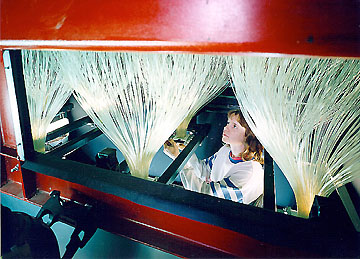 Craig serves as scientific spokesperson of the experiment
(with Kam-Biu Luk), which was the first major new
experimental effort initiated by the newly formed Experimental High
Energy Physics group at the University of Virginia.
The UVa group had a leading role in the construction of the spectrometer,
with the following responsibilities:
Craig serves as scientific spokesperson of the experiment
(with Kam-Biu Luk), which was the first major new
experimental effort initiated by the newly formed Experimental High
Energy Physics group at the University of Virginia.
The UVa group had a leading role in the construction of the spectrometer,
with the following responsibilities:
Status of the Analysis The analysis of the HyperCP dataset has reached a mature stage with 13 refereed publications. Highlights of the physics analyses include: